


RECIPE COSTER
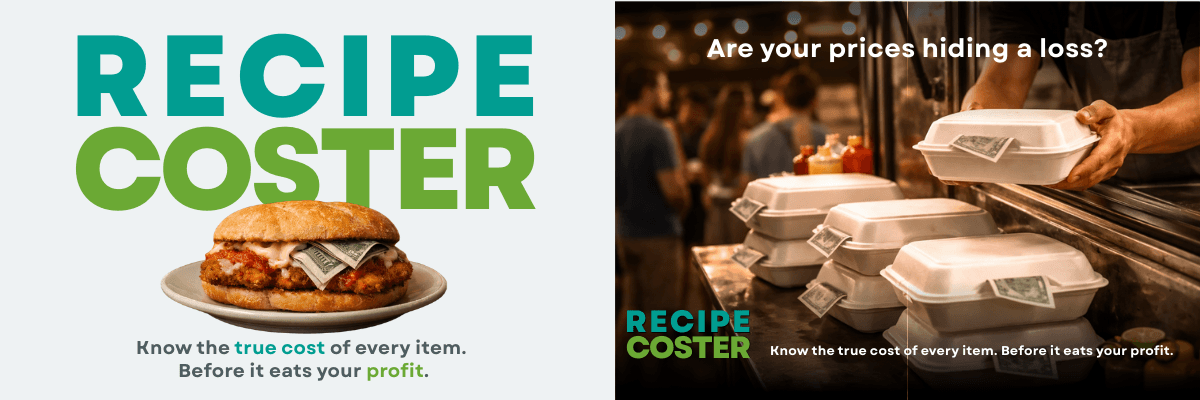
Ingredient costs creep. Margins disappear. Designed a SaaS that makes the problem visible before it becomes a crisis.
Data Visibility | Product UX | Decision Support Design
TL;DR
WHAT
SaaS website that makes recipe-level costs visible so small pricing changes don’t quietly erase margins.
WHY
I wanted to explore how small cost changes can quietly erode margins, and how better visibility could support smarter decisions without requiring financial expertise.
STATUS
UX portfolio case study. Full product spec, design system, and decision framework complete.
FOCUS
Making per-recipe cost drift visible through clear, approachable interfaces while keeping data entry light enough to be sustainable in real kitchens.
WEBSITE: https://recipecoster.framer.website/


This project wasn’t about building full accounting software.
It was about surfacing a specific problem that often goes unnoticed until it’s too late.
I focused on:
•
Understanding how ingredient price changes add up across real menus
•
Designing views that make cost drift visible at the recipe level
•
Reducing the time and mental effort required to keep data current
Rapid prototyping helped explore different approaches to clarity and effort.
Vibe coding and AI-assisted UX tools helped move quickly through layout ideas, calculations, and interaction models without over-investing early.
Constraints:
•
Inconsistent ingredient pricing and portion assumptions
•
Limited time and attention in busy food-service environments
•
The need to balance accuracy with usability and ongoing upkeep
The throughline was visibility.
Making financial pressure obvious early enough to act, without turning cost tracking into another operational burden.
This project explores how focused tools can support better decisions by revealing slow-moving problems before they become hard to fix.
HERE THERE BE DRAGONS
Every project has moments where the obvious answer wasn't the right one.
Here There Be Dragons is where those moments live, with enough context to show how my thinking about key product decisions, trade-offs, and constraints actually worked.
The Board Is the Product
The payoff screen is the home screen. Everything else in the app is setup. Get users to the insight first - let the product make the case for itself.
Insight to Action in One SteP
What If? shows you the blast radius before you enter a price, and lets you commit the new price the moment you've confirmed it's real. The confirmation modal preserves intentionality. The navigation penalty between insight and action is removed. A what-if tool that can't act on its own findings is only half done.
Snapshots, Not Analytics
Save runs as dated records. Decline the comparison chart. Decline the trend line. The right scope for this user is a list they can tap - not a graph they have to interpret.
Land Them in the Thing
No wizard. No guided tour. No front door. First login opens a fully populated sample workspace. The product makes its own case in the first ten seconds - because the user is already inside it.
Two Doors, Three Variables
Two access points to three settings, not three buried fields in Account Settings. The most load-bearing variables in the app are visible on the screen they govern. The modal mirrors the board header in layout and color - you're not editing settings, you're editing the score. That's the decision.