

REGIFTING IS OK
Turns out the hard part of regifting isn't the guilt. It's the memory.
Designed a fun, focused app that makes sure you never hand a gift back to the person who gave it.
Concept Product Design | UX Strategy | Rapid Prototyping
TL;DR
WHAT
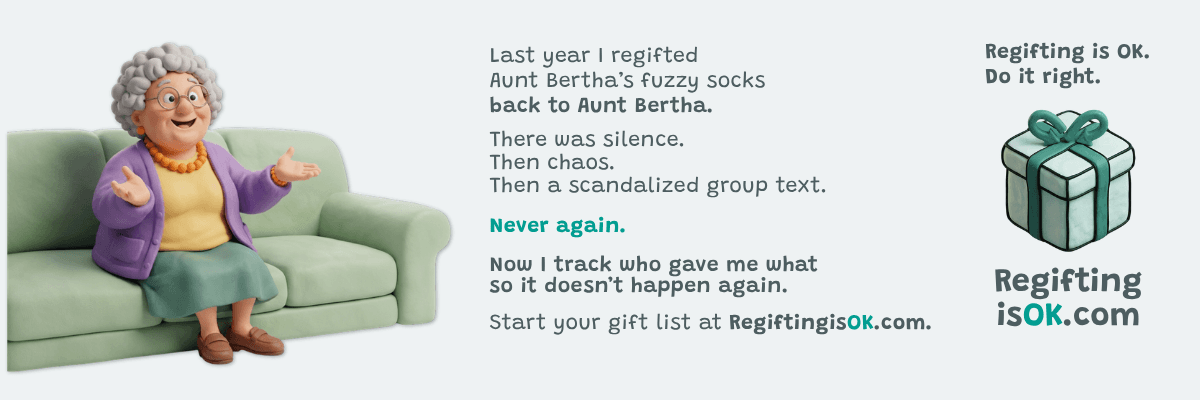
Website and app that helps you regift with confidence - without accidentally giving back the socks Aunt Bertha gave you for Christmas.
WHY
I wanted to explore how a small, well-scoped website and app could reduce everyday regifting anxiety, helping people save money and avoid embarrassment when budgets are tight.
STATUS
UX portfolio case study. Full product spec, design system, and decision framework complete.
FOCUS
Preventing social embarrassment through simple, low-effort tracking, while rapidly iterating the concept to test scope, flow, and real-world fit.
WEBSITE: https://regiftingisok.framer.website/


This project wasn’t about building a full-featured product.
It was about understanding a small, socially awkward problem and seeing how little structure was needed to make it easier.
I realized the problem wasn't regifting itself. It was memory.
I’ve got a shelf of perfectly nice gifts I don’t need, and the real risk isn’t passing them along, it’s accidentally handing one back to the person who gave it to me (or their family).
That’s the kind of mistake you only make once.
I focused on:
•
Identifying where embarrassment actually comes from in regifting scenarios
•
Designing for low-effort capture before items are stored or forgotten
•
Exploring how much value could be delivered with minimal data and very simple flows
The work emphasized rapid iteration. AI-assisted UX tools were used to move quickly through ideas, test assumptions, and surface edge cases without over-investing early.
Constraints:
•
People rarely think about regifting when they first receive an item
•
Any friction at capture time risks abandonment altogether
•
The system had to fit naturally into existing habits around storage and gift-giving
The throughline was restraint.
Deciding what not to track, what not to ask, and when simplicity matters more than completeness.
This project explores how a tightly scoped idea moves from ambiguity to structure, and where judgment is required to keep a helpful tool from becoming another obligation.
HERE THERE BE DRAGONS
Every project has moments where the obvious answer wasn't the right one.
Here There Be Dragons is where those moments live, with enough context to show how my thinking about key product decisions, trade-offs, and constraints actually worked.
One Photo. One Glance.
Reduced the experience to a single image per gift.
The instinct was multi-photo: more angles, more context. But this isn’t a marketplace. A gift record only needs to jog memory. One image does that. Everything else adds friction.
Find It Fast, No Search Needed
Search was considered, then cut. A search bar implies scale this app doesn't have and doesn't need. Instead, three filter chips (Status, From, Location) derive their values directly from the user's own data. No predefined lists, no open-ended query box, no UI clutter. The system uses what you already told it to help you find what you're looking for.
Free Text for Regift TO
Regift To is a plain text field, not a contact picker or dropdown. Recipients are unpredictable, and structured data here would slow everything down for no real gain.
Gift Details as Action Hub
Every action (edit, regift, delete) lives in one place. No inline actions from the list, no distributed controls. You always know where to go.
Images on the Right, Always
Thumbnails are right-aligned on every list row, every time. When no photo exists, there's no placeholder. The gift name simply takes the full width. Consistency over decoration.