

SEVEN PORTS
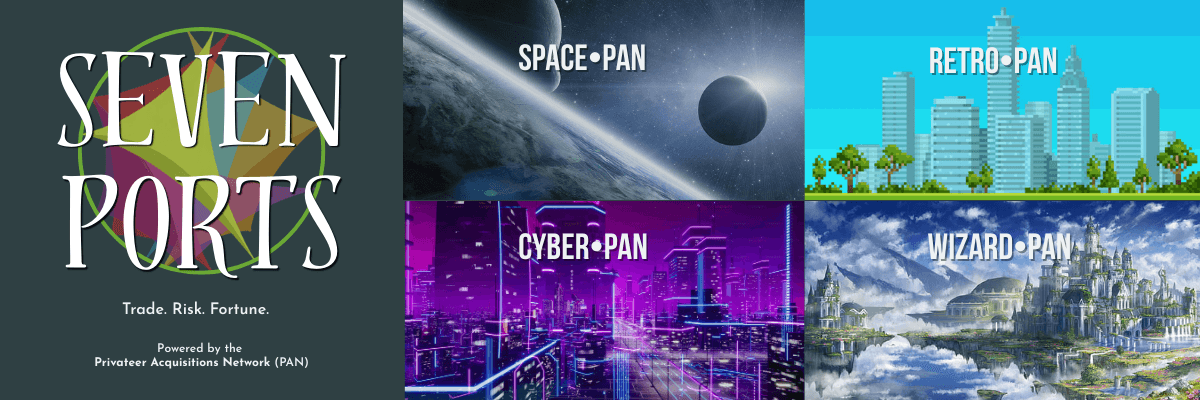
One online trading game, five different worlds wrapped around the same gameplay engine. The design challenge was making sure the themes never broke the gameplay.
Systems Design | Interaction Architecture | Product Experimentation
TL;DR
WHAT
A modern reimagining of the classic Taipan trading game, designed as a skinnable, systems-driven experience for contemporary platforms.
WHY
I wanted to revisit a long-standing idea and explore how in-game debt, trading decisions, and time pressure interact, and how UI clarity shapes player decisions.
STATUS
Design complete. Development pending.
FOCUS
Rapidly iterating interconnected game systems and UI themes while testing how far the experience could be modernized without losing the identity of the original game.
WEBSITE: https://sevenports.framer.website/


This project wasn’t about nostalgia or a visual refresh.
It was about revisiting a well-known game system and asking what still holds up, what needs clarity, and what breaks when brought forward to modern expectations.
I focused on:
•
Understanding the core economic pressures that made the original compelling
•
Clarifying interconnected systems like debt, trading, time, and risk
•
Exploring how UI skins and themes could change presentation without changing the mechanics
Vibe coding and AI-assisted UX tools were used to iterate quickly on rules, interfaces, and feedback loops, allowing ideas to be tested and discarded without overcommitting early.
Constraints:
•
Preserving the identity of the original game while modernizing interaction patterns
•
Preventing complexity from overwhelming readability and player decision-making
•
Designing systems that remain understandable and engaging over long play sessions
The throughline was balance.
Deciding what to modernize, what to leave untouched, and where clarity mattered more than added depth.
This project explores how a systems-heavy game can evolve through iteration, judgment, and restraint, without losing the tension that makes each decision meaningful.
HERE THERE BE DRAGONS
Every project has moments where the obvious answer wasn't the right one.
Here There Be Dragons is where those moments live, with enough context to show how my thinking about key product decisions, trade-offs, and constraints actually worked.
The Mechanics Are the Game. The World Is a CostumE
Rarely do we see spiritual successors of Taipan! move beyond the South China Sea setting. I looked at this differently. What is the gameplay actually about? It wasn't the setting, it was the tension. I kept that, and dressed it up five different ways. Same game. New outfit.
The World Doesn't Live Inside the UI. The UI Lives Inside the World
Most mobile games wrap the world in a frame and treat it as decoration. I didn't want that. I made the port image the entire screen and let the UI float over it. Every port should feel like somewhere you're standing, not something you're looking at.
Travel Stays Blind
No lookaheads. No price history. No destination trends. Every modern instinct says give players more information. The original got this right - the not-knowing is the tension. It stayed.
Debt Is the Only ReD
I gave red one job and protected it from everything else. When you see red on this screen you know exactly what it means without reading a word. One color, one meaning, no exceptions across five skins.
Wu Ex MachinA
I created a rescue mechanic that doesn't exist in the original, then hid it completely. No marketing, no in-game hints. When your run should end, there's a 5% chance it doesn't. The delight lasts about three seconds. Then you read the terms.